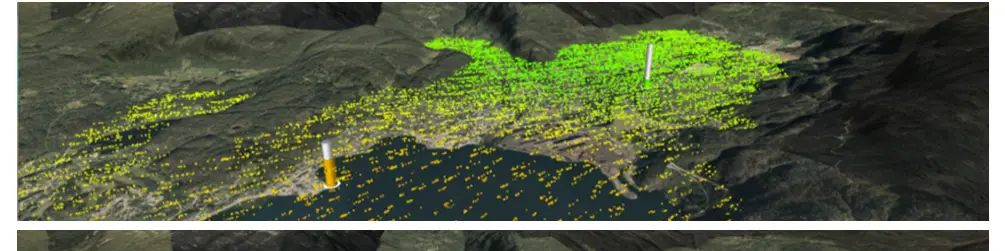
LIVEDUST - Pilot
Research prototype for monitoring spatially distributed ambient dust concentration sensors around industry
LIVEDUST aims to give industry-users a digital room for observing and evaluating their dust measurements from a distributed spatial instrument park in real-time. LIVEDUST will be a dashboard where functions such as rewinding and replaying events, incorporated video, and various types of data analysis and data harvest options are possible. Operations will be able to swiftly and efficiently, first understand, document and then communicate the status of emissions and air quality, the interplay between process, emissions and exterior factors, e.g. meteorology, topography and existing air pollution.
LIVEDUST will enable plants to effectively utilize continuous monitoring equipment differently and better than is possible today, and the adaptive data analysis that becomes possible, will potentially change how a plant operates. Ultimately, LIVEDUST will be a tool that helps the industries in achieving their zero-dust production capabilities faster, because it is a real-time learning-room and decision compass for emissions impact, and at the same time a verification and documentation tool of this mission. In addition, LIVEDUST will give grounds for new infrastructure or process optimization and can potentially be used in performing AI and MI learning, for modeling factory emissions “reality” scenarios, and for development of cognitive capabilities.
Industrial emissions impacts are generally low in Norway due to our clean production facilities. When emissions do cause an effect, they are in general episodic and added to what is already in the air from before. Since emission impacts are relatively small and can have a myriad of sources from within a production site, air quality impacts from process industry has proven to be a very complex issue to investigate and document. Fully functioning tools to be able to monitor and document the impacts continuously in real-time is not currently plug-and-play technology for industries as they must be tuned for specific instrumentation and data analysis needs that is different than regular city air quality functionalities. Furthermore, LIVEDUST technology will enable a transparent and trusting relationship between industries and neighbors.
Industries globally now face even stricter restrictions on emission levels and reporting, as the evidence grows on health effect related to air pollution[1],[2],[3],[4],[5], and all generators of pollution are under continued scrutiny. Specific priority today in land-based process industry and mining operations is on diffuse emissions, which are air borne pollutants that escape the emission treatment systems, and which have no standard measurement methodology in place yet. Dust is an important diffuse pollutant, and is many times visible to people living in communities next to the plant. The characteristics of dust particles, specifically their size, play a large part in how they travel in and interacts with the atmosphere compared to gases. Pollutant dispersion in general in the atmosphere is also greatly affected by meteorology and topography.
[1] Kuklinska et al, Air quality policy in the U.S and the EU – a review, Atmospheric Pollution Research, 6, 129-137, 2015
[2] Papadogeorgou et al, Low Levels of Air Pollution and Health: Effect Estimates, methodological Challenges, and Future Directions, Air Pollution and Health, 6, 105-115, 2019
[3] Fan et al, Ambient air pollution and depression: A systematic review with meta-analysis up to 2019, Science of the Total Environment, Volume 701, 2020
[4] Benmarhnia, Tarik, Linkages Between Air Pollution and the Health Burden from COVID-19: Methodolological Challenges and Opportunities, American Journal of Epidemiology
[5] Berman and Ebisu, Changes in U.S air pollution during the COVID-19 pandemic, Science of the Total Environment, Volume 739, 2020
LIVEDUST will enable plants to effectively utilize continuous monitoring equipment differently and better than is possible today, and the adaptive data analysis that becomes possible, will potentially change how a plant operates. Ultimately, LIVEDUST will be a tool that helps the industries in achieving their zero-dust production capabilities faster, because it is a real-time learning-room and decision compass for emissions impact, and at the same time a verification and documentation tool of this mission. In addition, LIVEDUST will give grounds for new infrastructure or process optimization and can potentially be used in performing AI and MI learning, for modeling factory emissions “reality” scenarios, and for development of cognitive capabilities.
Industrial emissions impacts are generally low in Norway due to our clean production facilities. When emissions do cause an effect, they are in general episodic and added to what is already in the air from before. Since emission impacts are relatively small and can have a myriad of sources from within a production site, air quality impacts from process industry has proven to be a very complex issue to investigate and document. Fully functioning tools to be able to monitor and document the impacts continuously in real-time is not currently plug-and-play technology for industries as they must be tuned for specific instrumentation and data analysis needs that is different than regular city air quality functionalities. Furthermore, LIVEDUST technology will enable a transparent and trusting relationship between industries and neighbors.
Industries globally now face even stricter restrictions on emission levels and reporting, as the evidence grows on health effect related to air pollution[1],[2],[3],[4],[5], and all generators of pollution are under continued scrutiny. Specific priority today in land-based process industry and mining operations is on diffuse emissions, which are air borne pollutants that escape the emission treatment systems, and which have no standard measurement methodology in place yet. Dust is an important diffuse pollutant, and is many times visible to people living in communities next to the plant. The characteristics of dust particles, specifically their size, play a large part in how they travel in and interacts with the atmosphere compared to gases. Pollutant dispersion in general in the atmosphere is also greatly affected by meteorology and topography.
[1] Kuklinska et al, Air quality policy in the U.S and the EU – a review, Atmospheric Pollution Research, 6, 129-137, 2015
[2] Papadogeorgou et al, Low Levels of Air Pollution and Health: Effect Estimates, methodological Challenges, and Future Directions, Air Pollution and Health, 6, 105-115, 2019
[3] Fan et al, Ambient air pollution and depression: A systematic review with meta-analysis up to 2019, Science of the Total Environment, Volume 701, 2020
[4] Benmarhnia, Tarik, Linkages Between Air Pollution and the Health Burden from COVID-19: Methodolological Challenges and Opportunities, American Journal of Epidemiology
[5] Berman and Ebisu, Changes in U.S air pollution during the COVID-19 pandemic, Science of the Total Environment, Volume 739, 2020